
Institution: Sustainable Development Solutions Network
W
U
- University of Delaware
- United Nations
- United Cities and Local Governments
- University of Pennsylvania
- Università di Macerata
- University of Oxford
- United Nations Development Programme
- UN Statistics Division
- UNESCO Information for All Programme
- United Nations Environment Programme
- University of Queensland
- Universidade Estadual do Rio de Janeiro (Federal Rural University of Rio de Janeiro)
- University of the Philippines
- University of California - Irvine
- University of Victoria
- UN-Habitat
- University of Cape Town
- University of Exeter
- United Nations Economic Commission for Africa
- UNICEF
- Università degli Studi di Siena
- Università degli Studi di Napoli Federico II
- Université de Sousse
- United Technologies Research Center
- Università degli Studi di Tuscia
- University of Jordan
- University of California - San Francisco
- UNESCO World Water Assessment Programme (WWAP)
- UNU-WIDER
- Unilever
- University of Gothenburg
- UNESCO
- United Nations Economic Commission for Europe
- UNESCO Global Network of Facilitators
- University of South Africa
- University of Antwerp
- University of Music Franz Liszt Weimar
- UNU-CRIS
- United Nations Office for Disaster Risk Reduction
- United Nations Institute for Training and Research (UNITAR)
- University of Southampton
I
- International Union for the Conservation of Nature
- International Monetary Fund
- International Institute for Applied Systems Analysis
- Institute for Sustainable Development and International Relations
- Indian Institute for Human Settlements
- International Telecommunication Union
- International Ocean Institute
- India Federation of Self Employed Women's Association
- International Civil Society Action Network
- International Institute for Environmental Development
- ICLEI - Local Governments for Sustainability
- Infosys
- International Labour Organization
- IHE Delft
- International Fertilizer Association
- Islamic Development Bank Institute (IsDBI)
- Istanbul International Center for Private Sector in Development (IICPSD)
- International Labour Organization (ILO)
- International Social Security Association
- Impact Actuarial
- International Cooperative and Mutual Insurance Federation
S
A
- Ain Shams University
- American University
- Athens University of Economics and Business
- African Center for Cities
- Association of Caribbean Energy Specialists
- All India Institutes of Medical Sciences
- Australian Resilience Centre
- Alliance for Global Water Adaptation
- Academy of Korean Studies
- Ahmedabad University
M
O
H
E
F
- Federal Government of Ghana
- Fundação Getulio Vargas
- Facultad Latinoamericana de Ciencias Sociales
- Federal Government of Chile
- Federal Government of the United States of America
- Foundation for the Global Compact
- FAS - Fundação Amazonas Sustentável (Amazonas Sustainable Foundation)
- Former President of Colombia
- Former Prime Minister of Norway
- Former UN Secretary-General
- French High Council for the Financing of Social Protection
C
N
- New School
- Natural Resource Governance Institute
- National Disaster Management Authority (India)
- National Research University Higher School of Economics
- National Wildlife Federation
- New York University
- Northumbria University
- National Autonomous University of Mexico
- National Institute of Archaeology and Heritage Sciences of Morocco
G
K
D
P
B


Guillaume Lafortune
Dr. Guillaume Lafortune is Vice President and Head of SDSN Asia at the UN Sustainable Development Solutions Network (SDSN). With Prof. Jeffrey Sachs, he established the SDG Transformation Center in 2023—the SDSN’s flagship program to advance long-term investment, policy and monitoring frameworks for sustainable development. Since 2017, Guillaume has coordinated the preparation of the Sustainable Development Report series (which includes the SDG Index and Dashboards).
Between 2020 and 2022, Guillaume was a member of The Lancet Commission on COVID-19, where he coordinated the taskforces on “Fiscal Policy and Financial Markets” and “Green Recovery”, and co-authored the final report of the Commission. He is also a member of the Grenoble Center for Economic Research (CREG) at the Université Grenoble Alpes. Previously, he served as an economist at the OECD in Paris and at the Ministry of Economic Development in the Government of Quebec (Canada).
Guillaume is the author of 60+ scientific publications, book chapters, policy briefs, and international reports on sustainable development, economic policy, and good governance. He studied at the Université de Montréal and the Ecole Nationale d’Administration Publique (ENAP) and earned his PhD in Economics from Université Grenoble Alpes in France.

María Cortés Puch
María Cortés Puch es la Directora del Programa de Redes para la SDSN. Antes de unirse a la SDSN, María trabajó para la UNESCO en la División de Políticas de Ciencia y Desarrollo Sostenible. Anteriormente, coordinó los programas europeos de energía y transporte en la Universidad Politécnica de Madrid, y trabajó durante dos años como Oficial Científico en la Oficina Española de Ciencia y Tecnología en Bruselas, analizando las políticas de la UE en materia de cooperación internacional, transporte y energía. Comenzó su carrera profesional en el Instituto Nacional de Tecnología Aeroespacial de Madrid como Oficial de Transferencia de Tecnología. María tiene una maestría en asuntos internacionales de la Universidad de Columbia (becaria Fulbright) y una licenciatura y máster en física por la Universidad Complutense de Madrid.
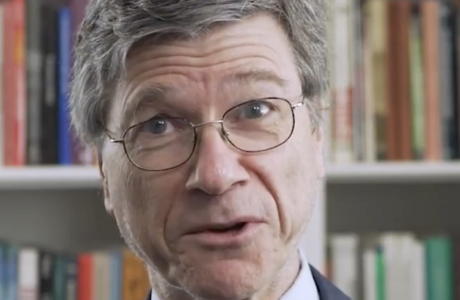
Jeffrey Sachs
Jeffrey D. Sachs is a world-renowned economist, bestselling author, innovative educator, and global leader in sustainable development. He is widely recognized for bold and effective strategies to address complex challenges including the escape from extreme poverty, the global battle against human-induced climate change, international debt and financial crises, national economic reforms, and the control of pandemic and epidemic diseases.
Sachs serves as the Director of the Center for Sustainable Development at Columbia University, where he holds the rank of University Professor, the university’s highest academic rank. Sachs was Director of the Earth Institute at Columbia University from 2002 to 2016. He is President of the UN Sustainable Development Solutions Network, Co-Chair of the Council of Engineers for the Energy Transition, academician of the Pontifical Academy of Social Sciences at the Vatican, Commissioner of the UN Broadband Commission for Development, Tan Sri Jeffrey Cheah Honorary Distinguished Professor at Sunway University, and SDG Advocate for UN Secretary General António Guterres. From 2001-18, Sachs served as Special Advisor to UN SecretariesGeneral Kofi Annan (2001-7), Ban Ki-moon (2008-16), and António Guterres (2017-18).
Sachs has authored and edited numerous books, including three New York Times bestsellers: The End of Poverty (2005), Common Wealth: Economics for a Crowded Planet (2008), and The Price of Civilization (2011). Other books include To Move the World: JFK’s Quest for Peace (2013), The Age of Sustainable Development (2015), Building the New American Economy: Smart, Fair & Sustainable (2017), A New Foreign Policy: Beyond American Exceptionalism (2018), The Ages of Globalization: Geography, Technology, and Institutions (2020), and most recently, Ethics in Action for Sustainable Development (2022).
Sachs is the 2022 recipient of the Tang Prize in Sustainable Development and was the corecipient of the 2015 Blue Planet Prize, the leading global prize for environmental leadership. He was twice named among Time magazine’s 100 most influential world leaders. Sachs has received 46 honorary doctorates, and his recent awards include the 2022 Tang Prize in Sustainable Development, the Legion of Honor by decree of the President of the Republic of France, and the Order of the Cross from the President of Estonia.
Prior to joining Columbia, Sachs spent over twenty years as a professor at Harvard University, most recently as the Galen L. Stone Professor of International Trade. A native of Detroit, Michigan, Sachs received his B.A., M.A., and Ph.D. degrees at Harvard.