Photo by Katja Ano on Unsplash
By Zifeng Zhang
Sustainable Development Goals. The first time I heard about this terminology was during a class on international educational development at university. I remember we had a long discussion about Prof. Jeffrey Sachs’s (2012) article “From Millennium Development Goals to Sustainable Development Goals.” The 17 goals covering all vital areas of everyday life of global citizens seem ambitious, but also mysterious.
At the UN Sustainable Development Solutions Network (SDSN), I finally had the chance to explore the meaning, progress, and development of the SDGs closely.
The Sustainable Development Goals are expectations for all countries and regions collectively. Collaboration was my first impression of the SDGs. By design, they cannot be achieved by a single country, institution, or sector alone. Coordinated efforts across different countries, civil society, academia, and communities at every level. It immediately raised one question in my head: How do we actually mobilize global knowledge across different sectors and regions so everyone can access it?
The SDG Academy has my answer. Their nearly 60 free online courses are delivered by experts worldwide from various international organizations and academic institutions, from different fields and different countries. Learners can explore one single concept from its application to various countries’ case studies.
My primary duty as an SDG Academy intern was to manage courses— reviewing, updating, and refining course content to ensure an accurate and smooth learning experience for global learners. I witnessed how responsible and meticulous the SDG Academy team is when they are handling the course content. Even though the content is free and open, the SDG Academy insists on providing the best quality and learning experience to every learner. By paying close attention to details and minimizing errors, I cultivated my professional ability and responsibility of detail-orientedness, a skill that seems small, but which will be beneficial for any work I do in the future. And, by doing comprehensive research and selecting the best suitable case studies and up-to-date journal articles for our courses, I cultivated my product-development insights and empathy for understanding what our target audiences want to get out of our course.
Working on the courses also deepened my understanding of the SDGs. I particularly liked the Measuring Sustainable Development course, which detailedly introduces how different data tools, such as the SDSN’s Sustainable Development Report and localized indices, can be used to track SDG progress. By diving into these tools, learners will understand the importance of rigorous monitoring and evaluation and data measurement in evidence-based policy and decision-making. More importantly, learners will know that SDGs are not visionary goals, but goals that can be tracked and assessed in real life.
I also liked Macroeconomics for a Sustainable Planet, which provides a set of macroeconomic tools to reduce poverty and inequality. More importantly, the course content is accessible to anyone without a prior background in economics, making all the complex terms approachable through vivid videos and real-life case studies. The course helps reinforce learners’ understanding of how macroeconomic design and policy choices can directly and indirectly influence the progress of SDGs.
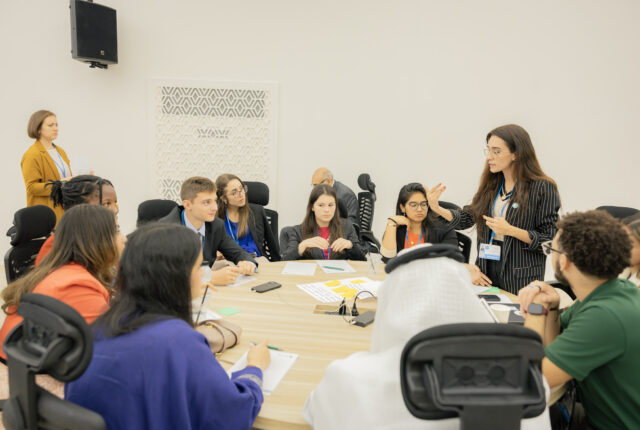
Beyond my daily internship tasks, I also got the chance to participate in all the meaningful events and webinars. For instance, I participated in the launch of the 2026 Sustainable Development Report. Over 200 academic scholars and panelists from countries worldwide gathered online to share their thoughts and questions about SDG progress. New opinions and minds collided in the most exciting ways. Prof. Jeffrey Sachs proposed establishing new UN campuses in Latin America, Africa, and Asia—a bold vision to bring the global collaborative effort more closely to the local communities. Also, I really appreciated the large-scale survey conducted as part of the Report—1,000+ responses from 127 countries on the perceived SDG progress. It reminds me that knowing the public’s perception and opinions is equally important as the real data. SDG progress includes not only the actual data and numbers from relevant fields, but also people’s feelings and perceptions, providing a more accurate and inclusive image for the development of SDGs.
As I read through the report, though, I was sad to find that none of the 17 SDGs are on track to be achieved by 2030. The deadline is not far away. By 2030, I will have graduated from my Master’s in International Educational Development and hopefully be working in international development. Perhaps I will be designing my first educational program, or evaluating an existing one. But as an education professional, I am sure I will keep attending the SDSN’s webinars, meeting professionals and experts from all over the world who are dedicated to SDG solution-building.
I heard a story when I was young: After a storm, a child was picking up fish on the beach and throwing them back into the ocean. Someone tried to stop the child, saying, “There are so many fish on the beach; you cannot save all of them. And look, nobody cares about these fish.” But the child did not stop. He kept throwing the fish back, replying, “This fish cares. And that fish cares.”
Not all goals will be met by 2030; but at least, because of the efforts of the SDSN, the SDG Academy, and the wider network, progress has been sped up. There are people picking up the fish. That is exactly the meaning of all our work. The ultimate success of sustainable development, whether or not we hit the 2030 deadline, will count on our continuous, cumulative efforts.
Thanks to my internship, I now look at my Master’s classes through an SDG lens. My experience has turned into an inner voice that keeps asking me, “Which SDGs does this assignment target? Is there data to measure the impact? Who is missing from that data?”
Now, when I am looking at an educational issue, I start to think, “Does this intervention match the requirements of SDG 4?”, especially when encountering circumstances where access is guaranteed but the quality of outcomes still remains low. I know that the answer is probably, “No,” because SDG 4 is about so much more than access—it’s about the quality of the learning.
My time with the SDG Academy amounted to more than just professional experience. It has helped me to understand the world I live in. From first reading about the SDGs in the classroom to working with an organization that strives to make these goals a reality, I have become more aware of how big goals are substantially associated with everyday small actions. Every course I manage, every error I minimize, every webinar I attend, is able to make much larger and meaningful contributions to a better world. And, as I look toward 2030, I have no plans of slowing down.

Zifeng Zhang is a Master’s student at the University of Pennsylvania, pursuing a dual degree in International Educational Development and Nonprofit Leadership. Her academic and professional interests center on teaching, social-emotional learning (SEL), and sustainable development. She taught at Upper Rhymney Primary School and Idris Davies School in the UK for one year, where she developed a grounded, practice-based understanding of teaching in the international educational context. She has also interned at Wispring Education Development Foundation in China for a year, gaining experience across the education and nonprofit sectors. She hopes to eventually establish her own nonprofit focused on Social-Emotional Learning (SEL).