By Minghan Ma and Johanna Huber
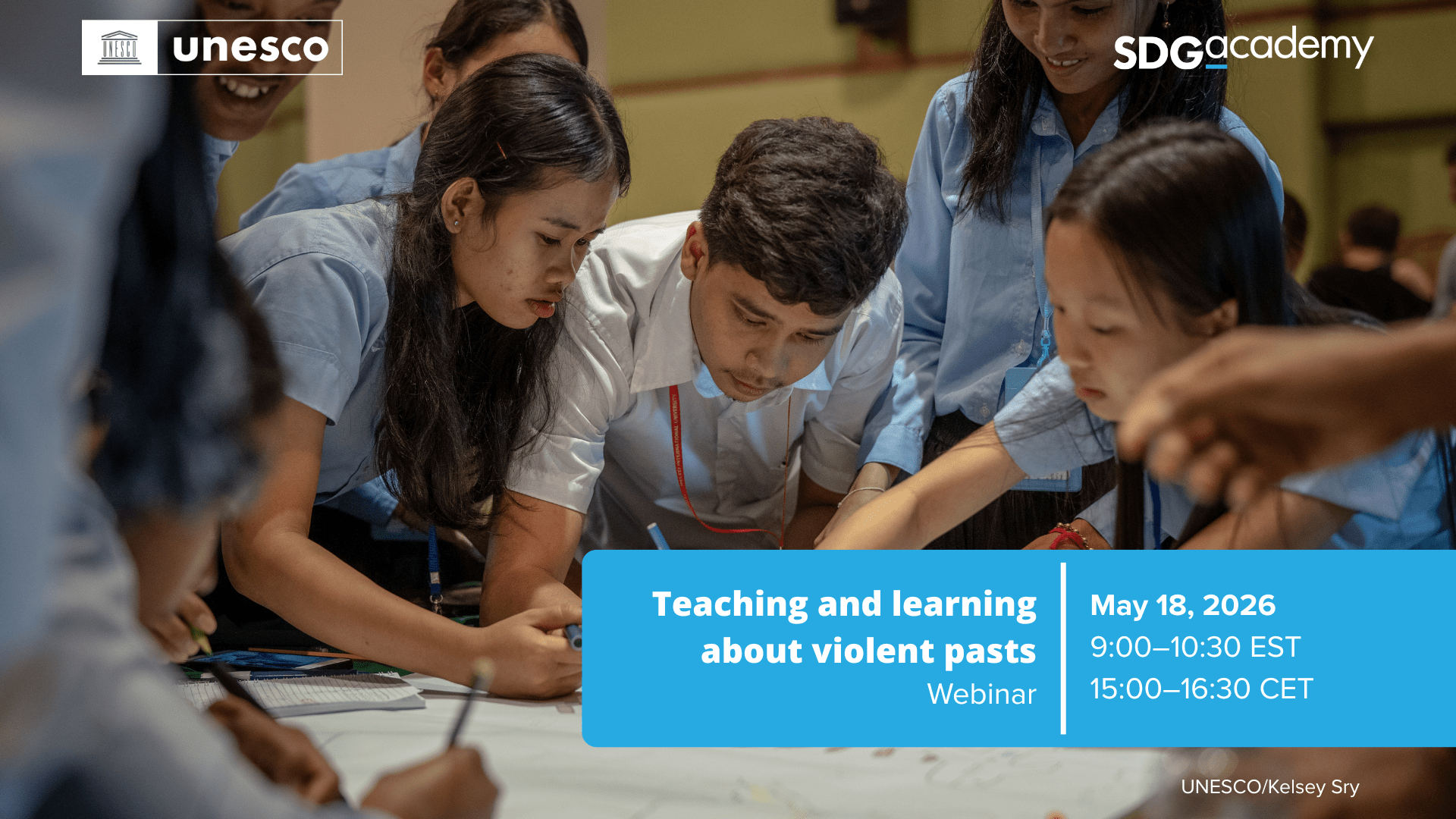
Marking the UN’s International Day of Living Together in Peace, the SDG Academy hosted a webinar on May 18 to launch their new online course, Teaching and Learning about Violent Pasts, produced in partnership with UNESCO. The conversation brought together global experts, educators, and practitioners to explore how historical narratives, ethical responsibilities, and courageous pedagogies can actively forge peace.
“Education can help learners better understand the past, engage responsibly with the present, and contribute to more peaceful societies in the future.”
Grounded in this mission, Cecilia Barbieri, UNESCO’s Chief of Section, Global Citizenship and Peace Education Sector, kicked off a critical dialogue on how education must confront violent histories—not as closed chapters of yesterday, but as living responsibilities today.
Pedagogies of Peace: Confronting the Past to Shape Our Present and Future
Michelle Bellino from the University of Michigan set a profound tone: “Silence is not neutral.” Because teachers and students inevitably carry societal biases into the classroom, ignoring violent legacies leaves a “dangerous vacuum to be filled by stereotypes and propaganda.” To confidently guide students through these difficult histories, teachers need four pillars of support: historical grounding, pedagogical tools, ethical guidance, and robust communities.
From South Africa, high school history teacher Lufuno Lerato Monguni brought this mission into the classroom. “Our role as educators,” she emphasized, “is to be facilitators.” By confronting their own emotional triggers to set a transformative tone, and using reflective tools like exit tickets, teachers can build safe, honest spaces where students unlearn deep-seated prejudices and learn to engage as active citizens.
Fragile classroom safety can shatter against active, ongoing atrocities. Webinar participants from Cameroon and South Africa shared the challenges that educators and learners face in the field. Their questions centered on a critical dilemma: how to sustain pedagogical inquiry while navigating national healing amid political instability and localized conflicts. Responding to these risks, Michelle advised that “safety comes first,” encouraging teachers to use indirect historical parallels as safer entry points for conversation. Ultimately, Isabel Tamoj, UNESCO Section of Global Citizenship and Peace Education, emphasized UNESCO’s next step: securing support for teachers from governments and institutions, declaring, “History is political.”
Two Classrooms, Two Destinies
This evocative dialogue resonated deeply with us, two postgraduates from China and Germany, respectively, who both chose to study International Political Economy (IPE) at University College Dublin (UCD) and are currently working with the SDG Academy over the summer trimester. Our reflections on our own high school history classes show how pedagogies shape our values.
Minghan
My historical awakening began with my grandfather’s silent television. As a veteran, he wordlessly watched war dramas and documentaries. Eager for cartoons, my young self never understood what those violent pasts meant to him. He never spoke of battlefield trauma, only stubbornly telling me to get into a good university and “develop” our motherland.

In high school history classes, what I remember most is five thousand years of Chinese civilization and systematic analysis of foreign invasions, from imperialist incursions that ended feudal society to the Japanese invasion. History has taught us that backwardness left us vulnerable to attack—underscoring the pain of underdevelopment. Therefore, my teacher focused on what this suffering forced us to learn to develop our nation, instead of dwelling on war tragedies and national hatred. Yet, though I memorized textbooks ten times to ace the Gaokao (National College Entrance Examination), I could not fully grasp the deep meaning of “development.”
My understanding began to shift after I worked in my beloved capital, Beijing, and later stepped onto the wider global stage. In Beijing, the blend of ancient history and modern skyscrapers gave me my real sense of contemporary development. This vision expanded in museums worldwide; when I saw the immense global footprint of ancient Chinese porcelain, a national pride woven into my bones found new meaning in China’s growing global presence. I realized that a global narrative can never bypass this massive Eastern civilization.
“Silence is not neutral.” — Michelle Bellino
However, during my studies at UCD, confronting geopolitical discourse nurtured a dual perspective, prompting me to ask myself: “Who am I in this complex world?”
Driven by curiosity about global narratives, my research into colonial heritage at UCD helped me uncover another layer of history, understand the human experiences behind those histories, and better grasp what Michelle meant when she said, “violence continues to shape people across generations.” In my IPE classes, synthesizing global hegemonies into a macro-picture helped me better understand China’s place in the world.
These unspoken stories from my grandfather and history teachers became my unique anchor, enabling me to view the world with empathy. Meanwhile, memorial halls, martyrs’ cemeteries, and air-raid sirens in my hometown filled these gaps and reminded me to be resilient.
Attending the Teaching and Learning about Violent Pasts webinar recontextualized these “silences” for me. I finally understand the weight of “development.”
My grandfather transformed a lifetime of suppressed trauma into the fuel to lift his family and develop our hometown. His life mirrors modern Chinese history and patriotic education, teaching me “self-discipline and social commitment toward national rejuvenation and lasting peace.”
UCD and the SDG Academy provided the vital next step: historical understanding can help turn past violence into future coexistence. Carrying these expectations, walking this new journey, I now understand who I am: shaped by development education, stepping onto the world stage with a “living responsibility” to promote peace and development—a global citizen.

Johanna
My home country of Germany has a well-known episode of violent history, with its Holocaust that started in the 1930s. My secondary school did a brilliant job educating us about our violent past in a constructive way—we spent two years of history class working through the complex Holocaust chapter, always circling around the question: How could people let this massive genocide happen?
We always looked at the “bigger picture” of the Holocaust—the series of historic events that led to it and the German population’s motives for putting their faith into Hitler’s ideology. So many layers which eventually built to this dramatic genocide that killed millions of people.
Our history education was great at balancing emotions, empathy, and rational understanding. In fact, my history teacher had grown up in East Germany in the 1960s and ‘70s and had well reflected his personal history and perspectives. We also did a field trip to the Dachau concentration camp as part of our curriculum.
Germany has also created various spaces outside the classroom to continuously remind today’s population of its violent history. Activists who fell victim to the Nazis are remembered through street names or bricks in the pavements. To support education and awareness, Germany uses a range of media, including interviews with Holocaust survivors, films, and literature such as The Diary of Anne Frank.
Overall, the Holocaust is not treated as a taboo topic. We acknowledge that silence is not neutral. On the other hand, though, because of its violent past Germany in the present is hesitant to show national pride. I contrast this with the many Irish flags I see when I walk around Dublin—the only time I see a German flag in public is during the World Cup.
Germany has now lived in peace for more than 3 decades—sometimes I wonder if our generation is too far removed from the violence and takes peace for granted. Perhaps because of this, recently, Germany’s right-wing AFD party has been growing in popularity. I can see some parallels to the 1930s here: in times of frustration and economic uncertainty, people turn towards the opposite extreme. This means that there is still work to be done for us in fully processing our history—ultimately, our generation’s job is to move forward and not repeat history.

Same Vision for the Future: Driving Development and Peace
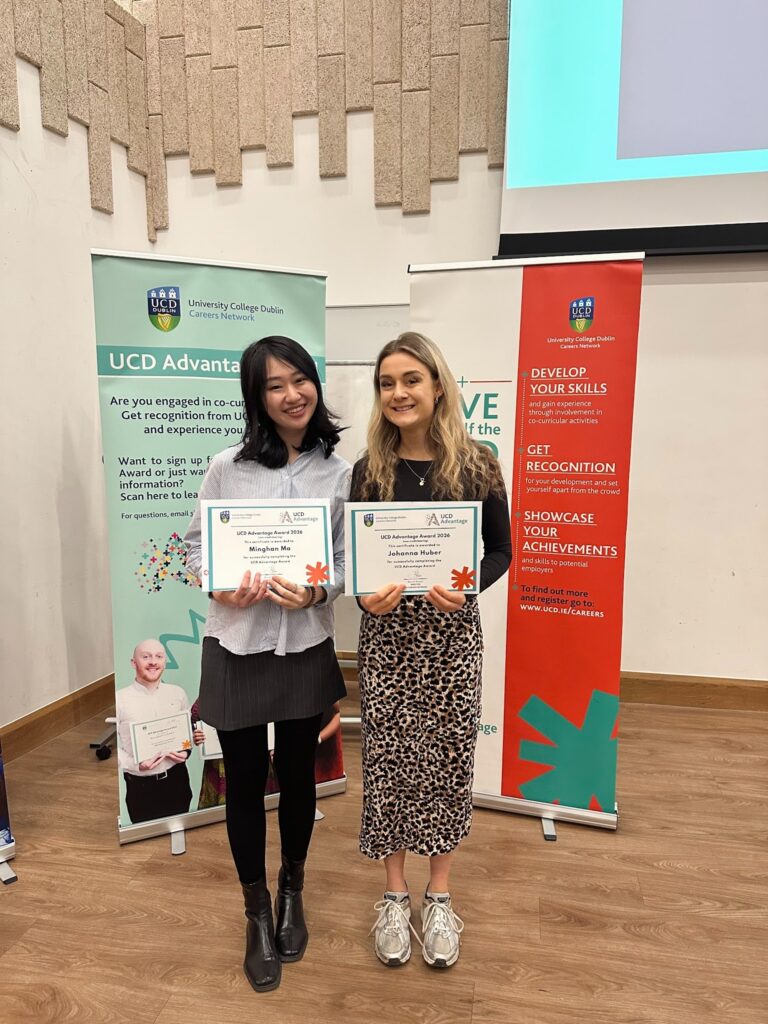
Despite our different experiences with history education, we share a common conviction in pursuing the same discipline.
With war never far away, study of history and the humanities remains crucial. From my perspective, history’s essential lesson is to shape upright, courageous citizens who resist hatred and conflict. Studying IPE at UCD deepened my understanding of sustainable development and what it takes to achieve the SDGs. My ultimate goal aligns with the ancient Chinese wisdom: Self-cultivation, family regulation, state governance, bringing peace to all under heaven. (Minghan)
My postgraduate studies in IPE at UCD show me the bigger picture every single day. The classrooms here are spaces where students from all parts of the world come together— countries with a variety of violent pasts, and many with violent presents. Our program bridges politics and economics: how economics affects people and societies, and ultimately determines conflict or peace. (Johanna)

Minghan Ma is a Master’s student in International Political Economy at University College Dublin, focusing on global governance, international investment and trade, and sustainable development.
Prior to UCD, she gained four years of working experience in Beijing across corporate education and public relations for multinational companies, including Amazon. She also supported cross-cultural exchanges with embassies, chambers of commerce, and international stakeholders during the Forum on China–Africa Cooperation.
Bringing a long-standing passion for global engagement to UCD, she now supports the SDG Academy’s summer project. Her favorite motto comes from Confucian thought: Self-cultivation, family management, state governance, and bringing peace to all under heaven. As a global citizen, Minghan hopes to advance the Sustainable Development Goals through education, dialogue, and international collaboration

Johanna Huber is a postgraduate student in International Political Economy at University College Dublin, where she has worked at the UCD Students’ Union to support students’ educational and financial needs.
She is currently assisting the SDG Academy as a summer intern with re-launches of MOOCs. Prior, Johanna has interned with an NGO in Vancouver to support education and labor rights across Latin America.
Johanna follows the idea of German naturalist Humboldt: “Everything is interconnected—everything is interaction and reciprocal”. You cannot touch the environment or local economies without affecting our entire global system. Johanna aims to work as a sustainability teacher to bridge the gap between the environment and economy.