
By Ian Ngugi
Getting into the Local Pathways Fellowship didn’t come easy. By the time I was accepted, I wasn’t just excited, I was ready.
The fellowship opened the door to the Sustainable Cities course by the SDG Academy. I came to it at a point where I was trying to figure out my next step — doing a research and knowledge management internship with the World Agriculture Forum, pursuing my art, applying for jobs, while trying to make sense of where my urban planning background fit into all of it.
But the strong urge that kept pulling me back was an earlier experience — 3 years working as an urban planning intern in Kerugoya-Kutus Municipality, in Kenya. One issue had stayed with me ever since: solid waste. Collection was unreliable. Policies were unapplied. People dumped and burned waste in the open. When it rained heavily, blocked drains caused flooding.

These weren’t alien problems. They were happening outside, in real time, affecting real people. And in the back of my mind, I hadn’t stopped thinking about them.
The course built understanding step by step — starting with the basics of sustainable cities, then moving into urban systems, poverty, inequality, and eventually governance and how change actually happens. Each module had a practical assignment that you had to submit. That’s what made it useful. You had to apply what you were learning, not just absorb it casually.
A few ideas stuck with me. The urban systems concept helped me see how waste connects to flooding and public health. The modules on inequality made me think harder about who suffers most when waste management fails — and why. The resilience section pushed me to think beyond the temporary fixes.
The course also did something I didn’t expect. It helped me find a way to connect my artistic side and my planning background. It sharpened how I notice things. I became aware and very observant of my surroundings. Months earlier, I had joined friends to paint graffiti on aging walls at the Embu Talent Academy grounds and ended up casually documenting it with my camera— the basketball, the murals, the vibe of people using a public space. I made a short film about it (which later birthed an article- Rethinking Public Spaces Through Art and Play). At the time, it felt separate from my planning work. But looking back, it was the same instinct — paying attention to how people relate to their environment. The course helped me see that connection.

But I kept returning to one question: how does any of this work in a place like Kerugoya-Kutus?
Waste isn’t just about optics, trucks and dumpsites. It links to health, flooding, jobs, economy and climate. The course helped me see that. But it also made the gap between theory and reality harder to ignore.
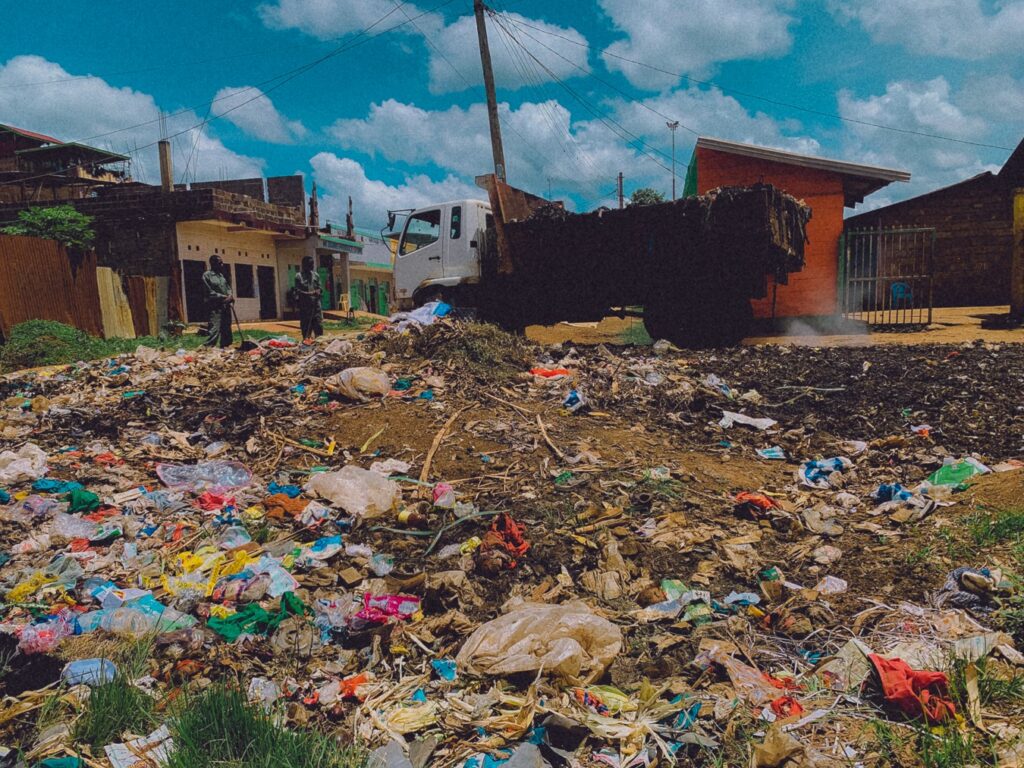
On paper, cities follow structured plans and enforce regulations. In practice — especially in smaller, growing towns and municipalities — it’s harder. Money is limited. Capacity is constrained. Enforcement is weak. Bureaucracy persists while priorities compete. Policies exist, but implementation is a whole different story.
That gap shaped the structure and approach of my project during the Local Pathways Fellowship. It’s titled “Climate-Responsive Solid Waste Management for a Cleaner Kerugoya-Kutus” The idea is simple: stop seeing waste only as a problem and start treating it as a resource — something that can be reduced, reused, or recycled in ways that also create income. That matters most in low-income and flood-prone areas, where poor waste management hits hardest.
The course gave me a useful framework. But I still had to adapt to it. Big systems work in well-resourced cities. Here, the focus has to be more localized and grounded — community involvement, small-scale recycling, better coordination between the right people.
One of the clearest lessons: knowledge isn’t enough. Moving from learning to doing takes time, patience, and input from other people. Building and maintaining relationships with stakeholders hasn’t been easy. There are skill gaps, resource limits, bureaucracy issues, and sometimes just low interest. To keep things moving, I’ve relied on simple tools such as WhatsApp and Zoom for following up and engagement.
Through the fellowship, I’ve also connected with young professionals from other parts of the world. Different cities, same problems — rapid urban growth, climate risks, gaps between policy and practice. What differs is how each of us responds.
For me, this experience confirmed something: young professionals have a real role to play. Not just in designing ideas, but in pushing for things to actually change. That means working within systems — and being honest when those systems aren’t working.
The course didn’t hand me solutions. It helped me ask better questions. And that’s been enough to move forward.

Ian Ngugi is a Kenyan urban and regional planner, researcher, and multidisciplinary artist. His work sits at the intersection of public policy, creative practice, and sustainable urban development. He has worked in municipal planning and climate resilience, and contributed research to the World Agriculture Forum on climate-smart urban agriculture and food security in Sub-Saharan Africa.
He is currently looking at how data centers compete with cities for land, energy, and water — and what that means for urban systems. He currently volunteers with StreetSmart, a Paris based civic-tech platform reimagining streets through data, design, and public engagement.
Ian is a 2025 Local Pathways Fellow and the founder of Pineapples and Concepts, a creative outfit working across film, music, fashion, and photography to document and reimagine urban life.