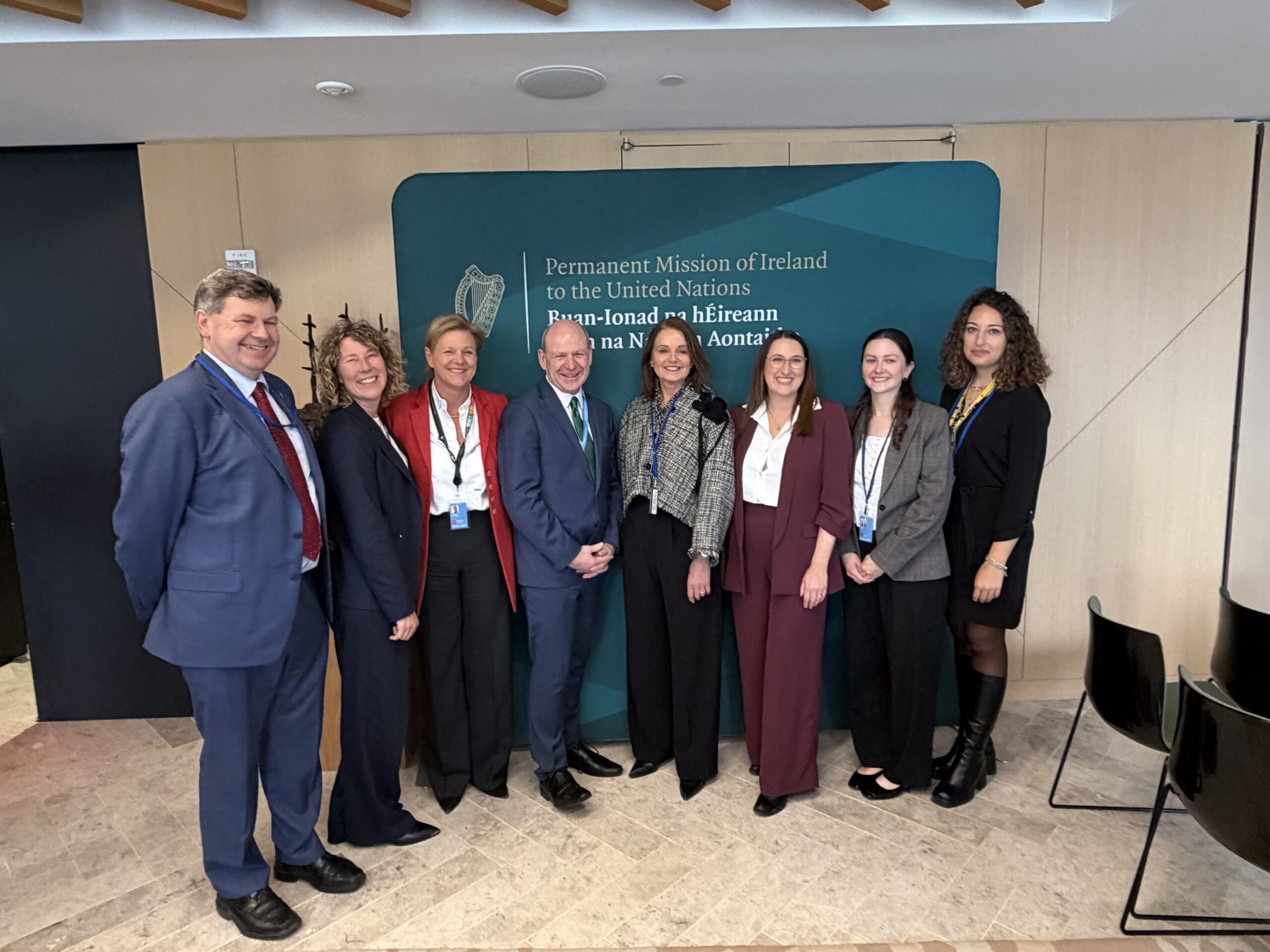
This event was hosted by the Permanent Mission of Ireland to the United Nations, co-organised by Soroptimist International and Graduate Women International, and sponsored by the Permanent Missions of Sierra Leone and Mongolia to the UN, as well as the UN Sustainable Development Solutions Network, UNESCO, the Dag Hammarskjöld Library and Credit Access India.
Scroll down to find the recording.
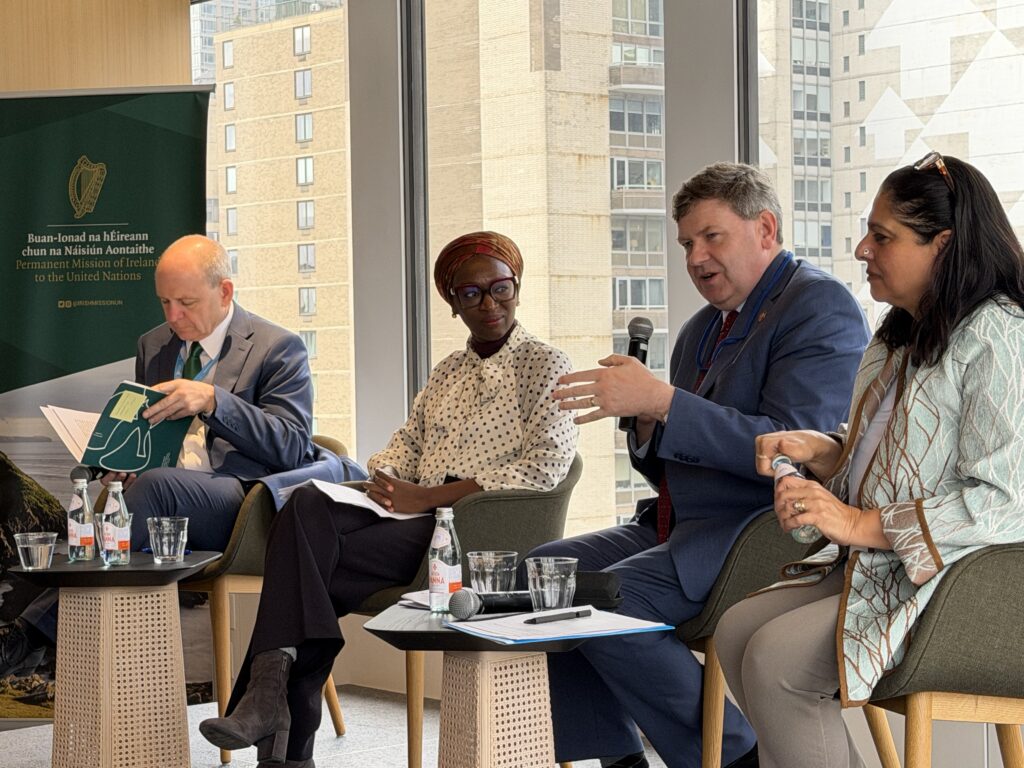
H.E. Fergal Mythen, Ambassador and Permanent Representative of Ireland to the UN (left) moderated the panel. He was joined by Ms. Nabila Aguele of the Malala Fund, Prof. Patrick Paul Walsh of the SDSN and University College Dublin, and Ms. Pia Britto of UNICEF
The Permanent Mission of Ireland to the United Nations hosted a compelling side event in the margins of the 70th Session of the UN Commission on the Status of Women (CSW70), co-organised by Soroptimist International and Graduate Women International, and sponsored by the Permanent Missions of Sierra Leone and Mongolia to the UN, as well as the UN Sustainable Development Solutions Network, UNESCO, the Dag Hammarskjöld Library and Credit Access India.
The event gathered cross-sector stakeholders including from the highest levels of government – Minister Emer Higgins of Ireland, Minister Isata Mahoi of Sierra Leone and Ambassador Fergal Mythen, Permanent Representative of Ireland to the United Nations – alongside civil society, UN agencies and the private sector, to explore the key role that education plays in ensuring equal access to justice for all women and girls.
Centring Girls and Local Leadership
Speakers included Nabila Aguele, Chief Executive of Malala Fund Nigeria, who emphasised that education must be recognised as the foundation for justice and opportunity. By centring girls and local leadership to effect change, girls become powerful agents with the ability to drive sustainable, context-driven solutions. This involves addressing broader social, economic and cultural barriers including poverty, conflict, displacement, disability and child, early and forced marriage, which remains a major driver of school dropout among girls.
Lifelong Learning and the Power of Knowledge
Professor Patrick Paul Walsh, Vice President of Education at the UN Sustainable Development Solutions Network (SDSN), highlighted the need for education to be redefined as a lifelong process. Millions of young people globally remain excluded not only from education systems but also from employment and training opportunities, forming what is often described as the “NEET” population (Not in Education, Employment or Training). This structural gap highlights the urgent need to embed lifelong learning into national education systems, ensuring that individuals can continuously acquire skills, adapt to technological change, and remain active participants in the labour market.
Rethinking Education Systems for the Digital Age
Pia Britto, Global Director for Education at UNICEF, acknowledged that digital technology offers a powerful tool to address this gap. Yet, technology alone cannot transform education unless the underlying system – which remains largely unchanged since the industrial era – also evolves. Teachers, therefore, must remain central to learning. Britto emphasised the need for a new “compact of mutual accountability” between governments, technology companies and communities. As artificial intelligence rapidly reshapes education systems, shared standards and responsibilities will be essential to ensure that innovation serves public goals rather than widening inequalities.
From Policy Reform to Collective Action
One common thread ran throughout the discussion: education is not only a pathway to individual opportunity but a powerful driver of justice, equality and sustainable development.
Moving beyond CSW70, educational justice requires multi-stakeholder cooperation and investment to ensure that educating all women and girls at all stages of life remains a global priority. This event was a first step forward, engaging new and existing partners across government, UN agencies, civil society, NGOs, and the private sector to promote education justice for all women and girls globally.
Watch a recording of Knowledge is Power below, on YouTube, or in the SDG Academy Library.