


Corporate Responsibilities for Sustainable Development
Length Length

6 videos

Price Price

FREE

Languages Languages

English

Prerequisites Prerequisites

A strong internet connection that can support viewing

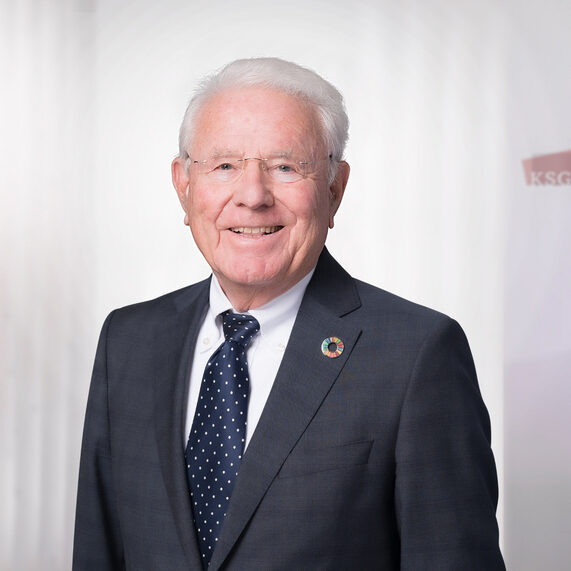
Join economist Klaus M. Leisinger
to explore business ethics and

corporate responsibilities.

Join economist Klaus M. Leisinger
Government. Business. Civil society.
How do we divide responsibilities

for societal transformation?

Government. Business. Civil society.
Businesses must find legitimacy
in sustainable development,

not only legality.

Businesses must find legitimacy
Learn six steps
for ethical decision-making

in the corporate sector.

Learn six steps

Overview

This video series is available for free in the SDG Academy Library.

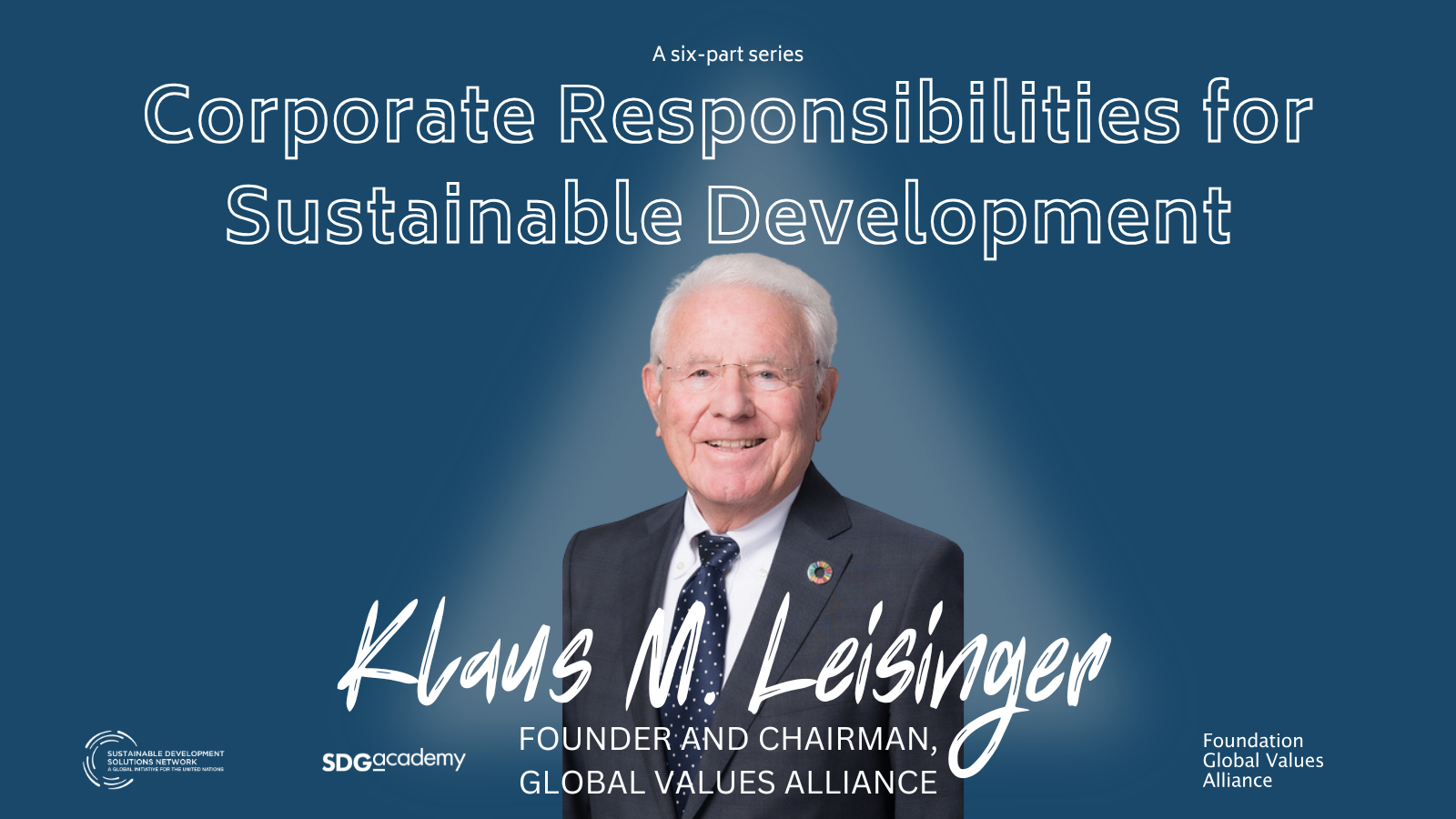
Corporate Responsibilities for Sustainable Development is a six-part webinar series led by Professor Klaus M. Leisinger, economist and Founder and Chairman of the Global Values Alliance. In this series, Prof. Leisinger explores the ethics of corporate responsibilities for sustainable development and the role of business in turbulent times.

You will have the opportunity to learn from Prof. Leisinger’s decades of experience as a business leader, academic, and activist working to transform ethical standards in the private sector.

For more than 30 years, Prof. Leisinger has worked internationally for a globalization “with a human face.” His efforts to transform corporate ethical standards–both morally and pragmatically–are groundbreaking, not only in the private sector but also in the academic field, especially since he understands how to test theories based on practical experience in the private sector. His influence on the acceptance of the UN Global Compact within multinational business circles and his communicative actions to reduce ideological reservations between different social interest groups are unprecedented and have brought him international recognition.

He is Professor of Sociology (em.) at the University of Basel (specializing in development policy, business ethics, and corporate responsibility), and was special advisor on the Global Compact for UN Secretary-General Kofi Annan, on business ethics to the UN Global Compact, and on the post-2015 development policy agenda upon termination of the Millennium Development Goals period. He was a member of the Consortium Board of the Consultative Group for International Agricultural Research (CGIAR) and is a member of the Leadership Council of the UN Sustainable Development Solutions Network (SDSN) initiated by the UN Secretary-General Ban Ki-moon and directed by Professor Jeffrey Sachs. For his humanitarian achievements and “bridge building” with NGOs, he has been awarded honorary doctorates in theology and in philosophy.

structure

Lead Faculty

  • Faculty Image

    Klaus M. Leisinger

    Global Values Alliance

This course is for

Business executives looking to lead with integrity

Policymakers and professionals who seek to encourage mobilize the private sector for sustainable development

Advanced undergraduate and graduate students interested in business and society

Questions?

Course logistics and requirements

This video series is available for free in the SDG Academy Library.

Certificates

There is no certificate available for this course.

syllabus

1

Introduction and context

Prof. Leisinger examines the context for corporate responsibility in the age of sustainable development, the fair division of responsibility for societal transformation, and the role of business in creating a better world.

2

What are corporate responsibilities for sustainable development? How do we deal with stakeholders?

Prof. Leisinger discusses a realistic approach to identifying and managing stakeholders in business activities.

3

How does value management work?

Prof. Leisinger outlines the differences of business legitimacy in an ethical sense, as opposed to simple legality.

4

The role and responsibilities of leaders

Prof. Leisinger discusses the kind of leadership required to obtain legitimacy, and how such a business leader must balance a principled pragmatism with the philosophical “ivory tower” of ethical behavior.

5

The so-called “business case” in different perspectives

Prof. Leisinger presents the business case for ethical conduct and examines different philosophical perspectives to guide ethical decision-making.

6

Ethical decision-making, dilemmas of responsibility, and situational ethics

Prof. Leisinger lists six steps for ethical decision-making and gives learners guidance on how to consider ethical dilemmas in different contexts.