by Tina Gupta
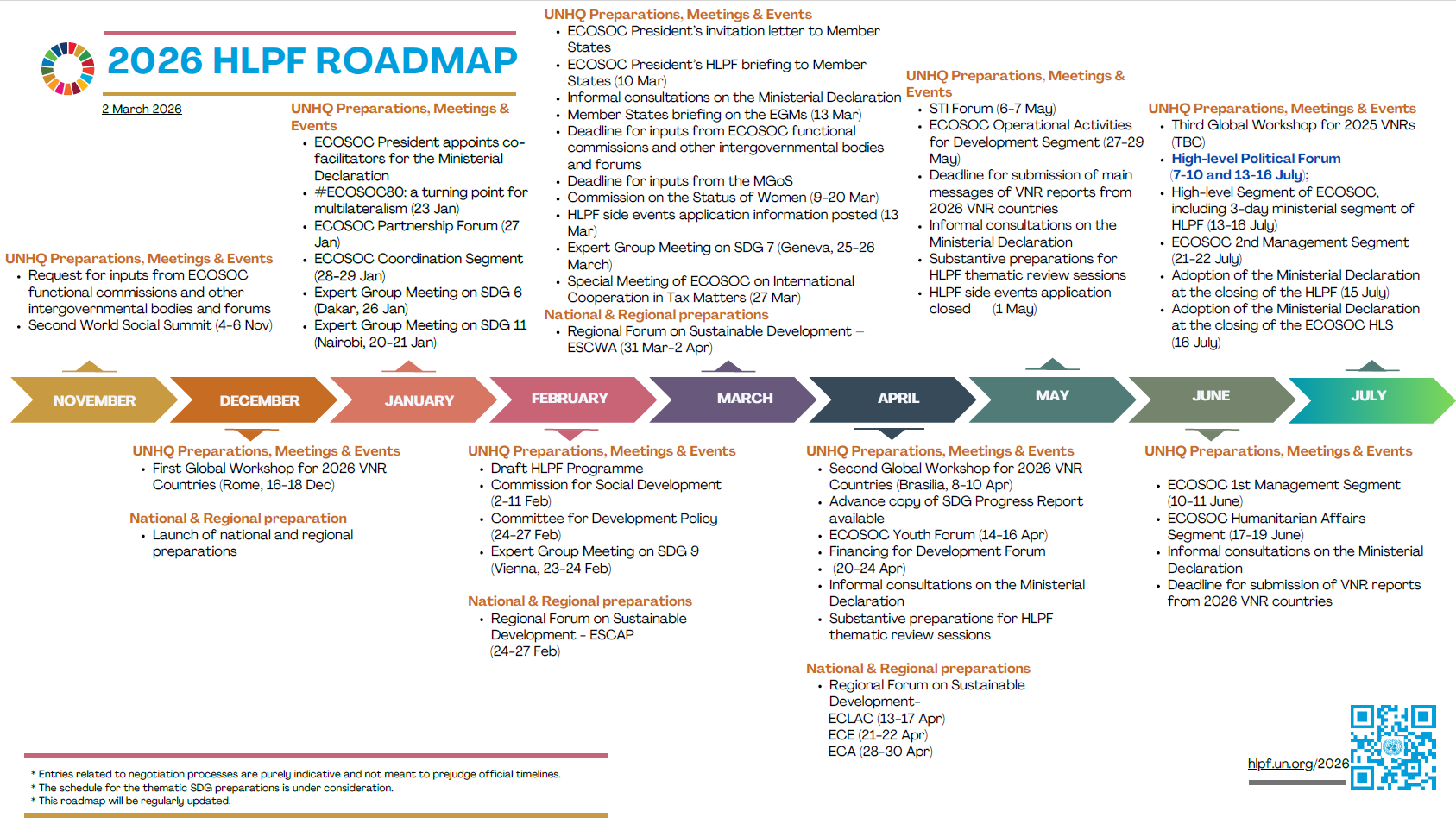
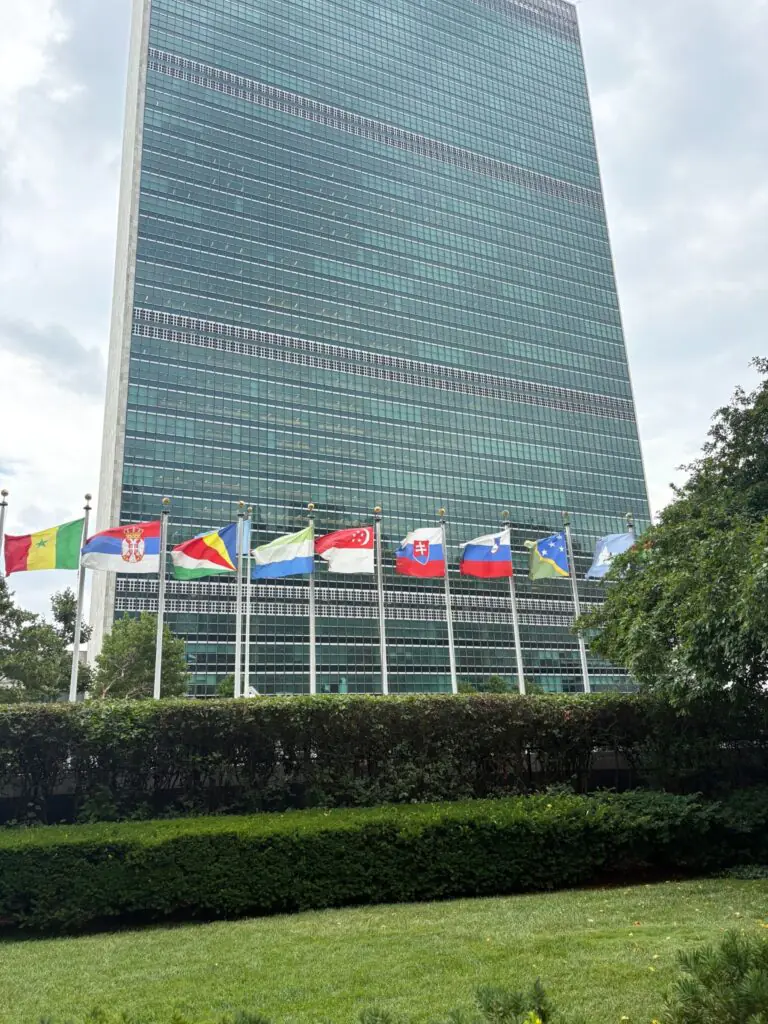
Each July, the High-Level Political Forum (HLPF) convenes at the United Nations as the central platform for reviewing global progress on the Sustainable Development Goals (SDGs). It is, in theory, a space of accountability where countries present updates, institutions share progress, and stakeholders assess how far we are from achieving the 2030 Agenda. In practice, the HLPF is more complex. It is where policy ambition meets implementation reality.
The 2026 theme, “transformative, equitable, innovative and coordinated actions for the 2030 Agenda”, felt particularly pointed. With less than five years remaining, the language has shifted from incremental progress to whether systems themselves can change fast enough. This year placed specific emphasis on SDGs 6 (water), 7 (energy), 9 (industry and innovation), 11 (cities), and 17 (partnerships), but what became clear across sessions is that these are deeply interdependent systems that either move together or stall together.
I come from a background in climate and sustainability, including a Master’s in Climate and Society from Columbia University’s Climate School. More recently, working across operations and supply chains, I’ve become increasingly interested in how large-scale goals translate into day-to-day decision-making.
The SDGs are often discussed at a high level: targets, indicators, and frameworks. But what do they look like in practice? How do energy transitions actually get financed and implemented? What happens when sustainability goals collide with economic or political constraints? Where do unintended consequences emerge? The HLPF sits at that intersection. It is one of the few spaces where systems thinking moves beyond theory and is actively debated, negotiated, and applied in real time.
Governing Interconnected Systems
One of the most compelling sessions I attended, Humanity at the Center: Global Citizenship, Ethical AI, and the Water–Energy–Food Nexus for Transformative SDG Action, approached sustainability through the water–energy–food nexus, emphasizing that these systems cannot be governed in isolation. While this framing is not new, what stood out was how it connects to implementation layers like supply chains. In practice, these systems materialize through production, logistics, and infrastructure, where decisions made in one domain inevitably ripple across the others.
A particularly impactful perspective came from Kaveh Madani, an environmental scientist, former Deputy Head of Iran’s Department of Environment, and fellow UC Davis alum, who is now a professor and researcher focused on water resource management and sustainability systems. His work on water stress, environmental governance, and systems modeling has made him a leading voice in global water and sustainability discussions. He framed the current moment within the context of the Fourth Industrial Revolution. Technologies like artificial intelligence are rapidly reshaping how these systems operate, often positioned as solutions that can optimize efficiency and improve decision-making. These systems require significant energy, water, and land resources, and as their use scales, so does their impact. In solving one problem, what new problems are we creating?
The issue with AI is that its impacts are not being fully accounted for within sustainability frameworks. The idea of unintended consequences came up repeatedly, alongside the need to mitigate them. Madani described the world as entering a state of “water bankruptcy,” where natural systems are degrading faster than they can regenerate. Protecting water, in this context, requires preserving the ecological systems that produce it. This perspective also invites actors often overlooked in high-level discussions. Farmers, for instance, manage the majority of global freshwater resources, making them crucial to any meaningful progress on SDG 6 and SDG 2. The conversation moved further into critical mineral supply chains, which underpin clean energy technologies and digital infrastructure. While essential for progress on SDGs like 7 and 9, their extraction often carries significant environmental and social costs, particularly in the Global South. The query here is difficult but unavoidable: how do we build a sustainable future without externalizing harm in the present?
Building an Inclusive Global Energy Transition
The Global Energy Interconnection Development and Cooperation Organization (GEIDCO) energy event built on these ideas, grounding them in infrastructure, finance, and geopolitical realities. GEIDCO is an international organization that promotes the development of global energy interconnection systems to accelerate clean energy transitions through cross-border electricity networks. The event explored how large-scale energy infrastructure, financing mechanisms, and regional cooperation can support progress on SDG 7 while aligning with broader development goals.
At its core was a simple but unresolved tension: the energy transition is both a climate necessity and a development challenge. Much of the progress on SDG 7 is concentrated in advanced economies, while developing countries face the steepest barriers to entry, including high capital costs, limited access to financing, and gaps in technology and institutional capacity. These regions also often hold the greatest renewable energy potential. This creates a structural imbalance. Expecting developing economies to lead the transition while absorbing disproportionate costs is neither realistic nor equitable. What emerged clearly is that the transition must be globally coordinated and financially inclusive if it is to succeed.
A key takeaway from this session was that we can no longer treat energy as a standalone sector. Progress in energy access and electrification is interlinked to advancements in water systems, industrial development, and urban infrastructure, linking SDG 7 closely with SDGs 6, 9, and 11. Fragmented approaches across these areas are unlikely to deliver meaningful results. Instead, what is needed is integrated planning, where electrification, industrial growth, and social development are aligned. Regional cooperation models illustrated how this can be actualized, including initiatives like the Pan-Arab energy market, West Asia regional cooperation frameworks, Asia-Pacific grid integration efforts, and African Union–led regional energy strategies. These examples highlighted interconnected systems that work beyond national borders and support economic resilience and energy security.
Despite declining costs of renewable energy, access remains uneven. High costs of capital, unequal access to technology, and capacity constraints continue to limit large-scale deployment. Addressing these gaps requires building systems that can sustain clean energy over time.
The importance of partnerships, reflected in SDG 17, was evident. The energy transition depends on cross-border infrastructure, shared technology, coordinated policy, and aligned financial systems. Clean energy is more than just decarbonization for developing nations; it is also about industrial strategy, job creation, manufacturing, and long-term economic positioning. This raises an important question: who captures value in the energy transition, and where does that value remain?
Across all sessions, consistent themes emerged that directly reflect this year’s HLPF focus. Systems thinking is not optional; the SDGs cannot be achieved in isolation. Trade-offs are inevitable and to be managed. Equity determines if the transitions are feasible. Partnerships function as the mechanism through which progress happens. Clean energy requires critical minerals, AI improves efficiency but increases resource demand, and development pathways carry opportunity and risk. Sustainability, in this sense, means making visible trade-offs that are governed responsibly.
Attending HLPF 2026 reinforced something I’ve been increasingly aware of: we are not short on solutions, we are short on alignment. The technologies, the frameworks, and the knowledge exists. What remains uncertain is coordination across systems, aligning incentives across actors, and moving quickly enough within the constraints of real-world politics and economics. The SDGs were never meant to be easy, but what this week made clear is that achieving them will require more than ambition. It will require a fundamentally different way of thinking about systems, responsibility, and scale. And perhaps that is the real role of the HLPF: not just to track progress, but to push that shift in perspective.

Tina Gupta is a Communications Intern with the Sustainable Development Solutions Network (SDSN), where she supports the SDG Academy in New York City. She holds an M.A. in Climate and Society from Columbia University and a B.S. in Environmental Sciences and Management from the University of California, Davis. She is interested in climate, sustainable development, and food systems, with a focus on making complex environmental issues more engaging and actionable.